

Autumn brings
the gold of the sea
Djursland has more than 260 kilometres of varied coastline, but it matters which beach you choose if you want a good chance of finding the Nordic gold — amber.
Here you can see where the chances are best.
General rule of thumb:
You rarely find amber on clean sand. Always search the tide line – the dark band of seaweed,
shells and especially the so-called “amber sticks” (small, black, light pieces of
half-rotten wood).
Where are the chances best?
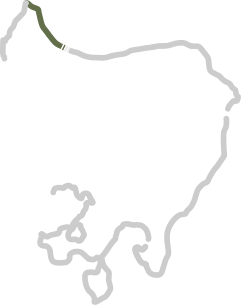
Udbyhøj - Hevring
Chances: Moderate.
The area: You can certainly find amber on this stretch, but in general the
opportunities are not as good as on the open amber beaches further east.
The stretch is worth a visit, though, if the sea has been rough for a long period.
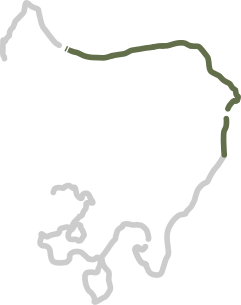
Hevring - Havknude
Chances: Good.
The area: These are the most interesting stretches on the map if you want
to find amber.
The opportunities are particularly good around Rygårde, Fjellerup, Bønnerup, Gjerrild and
Grenå.
Tip: At Gjerrild Nordstrand the chances of finding amber in the tide line are particularly good after strong winds from the north and north-west.
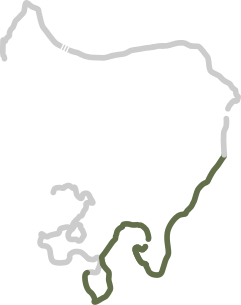
Havknude - Dragsmur
Chances: Generally smaller.
The area: The opportunities here are smaller than on Djursland's north and
north-east coasts.
Conditions vary a great deal, and wind direction, wind strength and current all play a big part
in whether amber is carried towards the shore.
Around Sletterhage, among other places, the coast is characterised by stones and deep water
close to land. That makes it difficult to find amber here, and the chances are small.
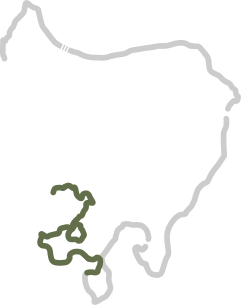
Dragsmur - Kalø Vig
Chances: Small.
The area: These stretches are generally less interesting for amber hunting
because several of the coasts are more sheltered. That does not mean amber cannot be found.
After strong winds it can still be worth examining fresh flotsam along the coast. Look
especially for places where seaweed, small pieces of wood, shells and other material have
gathered, as amber can be found among the flotsam.
The best time for amber hunting
When the wind dies down: Strong wind matters because the waves can loosen amber from the seabed. Go out when the wind starts to ease off and the current takes over in deciding where the amber drifts.
Remember to be patient: On Djursland's east coast it can take from around 8 hours up to 2 days before amber that has been set in motion reaches the shore.
Amber hunting in the dark with UV light (amber torch)
Amber can also be found after dark with the help of an amber torch.
When amber is lit with ultraviolet (UV) light it fluoresces and becomes easier to spot in the dark.
Walk slowly along the beach and shine the light across the flotsam.
Always bring an ordinary head torch as well, so you can find your way.
Is it real amber? How to test your find
It can be hard to tell a piece of amber from a stone when the find is lying wet on the beach.
Here are some simple methods you can use to examine your find:
The salt water test: Amber has a low density and can float in sufficiently salty water. Mix about 150 grams of salt into 1 litre of water and place the find in the water. If it floats, it may be amber. The test is not conclusive, though, as other light materials can float too.
Rubbing: Gently rub the amber against a piece of cloth. Amber can become statically charged and then attract small, light objects such as scraps of paper.
A quick safety rule: beware of phosphorus
The risk of finding white phosphorus on Djursland is extremely small, as the problem is mainly
found on the west coast of Jutland and on Bornholm. But because phosphorus residue from the Second
World War unfortunately looks like amber and can self-ignite at body temperature, you should make
one thing a firm habit — use a jar: Never put your finds straight into your
trouser pocket on the beach. Put them in a jam jar or a plastic tub instead, until you have tested
them at home.
Have a great trip!